
Articles
- The world of Chaucer 1330-1400
- Medieval writers
- Key events
- Making sense of the tangible world
- Making sense of the intangible world
Attitudes to women in medieval writing
Changing emphasis
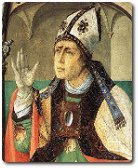 One of the great teachers who influenced medieval thought was St Augustine of Hippo (354-430 AD), who believed that a key component of original sin was human sexuality in its fallen state (see Fall of humankind). He also propounded the view that Mary, the mother of Jesus, remained a perpetual virgin – a view hard to sustain from a reading of the New Testament, but one that has been maintained by the Roman Catholic Church. Thus arose the two extremes of female presentation, as being like Eve or Mary, the madonna.
By the Middle Ages, it was commonly accepted that Eve was principally to blame for the disobedience that led to the fall of humankind. Greek ideas had affected Christian thinking, including the notion that the soul was good but the body evil. Thus sexuality came to be regarded as somehow evil. It is sad that one of the few medieval women writers, the mystic Margery Kempe, felt guilty about the inordinate love and physical desire she had felt for her husband in her youth, and later aspired to celibacy even within marriage.
Madonna or whore?
Unsurprisingly, medieval stereotypes of women were quite polarised. Women were seen either as saints capable of rejecting their sexuality totally, or as the very embodiments of temptation. The cult of the Virgin Mary grew alongside the view that, although child-bearing was an unfortunate necessity, sex was  not really a good thing and women were dangerous temptresses.
The courtly love tradition (See The world of Chaucer > The intangible world > The courtly love ethic) might be seen as giving women an elevated status. Few women however had the status of ‘lady'. And some of those who did were rather ambiguous morally: the great romances of Lancelot and Guinevere, or Tristram and Isolde, were based on what were essentially adulterous relationships, that resulted in personal or social tragedy.
Chaucer's women
Although women feature strongly in Chaucer's earlier works, such as The Boke of the Duchess and Troilus and Criseyde, we only find three women on the pilgrimage described in The Canterbury Tales:
- The Wife of Bath
- The Prioress
- ‘Another nun' who accompanies her but is hardly mentioned again.
The two principal women reflect the only ways that women at the time could achieve independence and status:
- In the Church
- In a trade.
The Wife of Bath represents the latter, whose skills, such as weaving, gave them financial independence, though Chaucer's character seems to have grown wealthy mainly by marrying a series of rich old men.
It is tempting to see the Wife as a champion of female rights, and her Tale brings out the idea that women should have maistrie over men, but the Wife is of course a character in a story written by a man. She has had five husbands, ‘withouten oother compaignye in youthe'.
Chaucer's Wife of Bath is similar to the stereotype of harridan or ‘shrew', which can be found in other medieval writings (for example, Noah's wife, in some of the Mystery plays). The Wife marries her fifth husband for love rather than riches, but he proved to be less compliant – and very well read. She claims to have put him in his place eventually, but Chaucer enjoys making the Wife recount (and try to refute) all the misogynistic tales with which he has assaulted her.
More on Chaucer's women: Some critics have seen a debate within The Canterbury Tales on marriage and on the respective roles of husband and wife. The Tales associated with this debate, apart from the Wife of Bath's, include the Clerk's Tale, the Merchant's Tale and the Franklin's Tale. The Miller's Tale might also be considered.

